Teaching Jev to Play Pokémon.
Results & methodology.
The evidence behind the article: a collection of 376 designed battle situations, archived experiment results, and the original methodological notes.
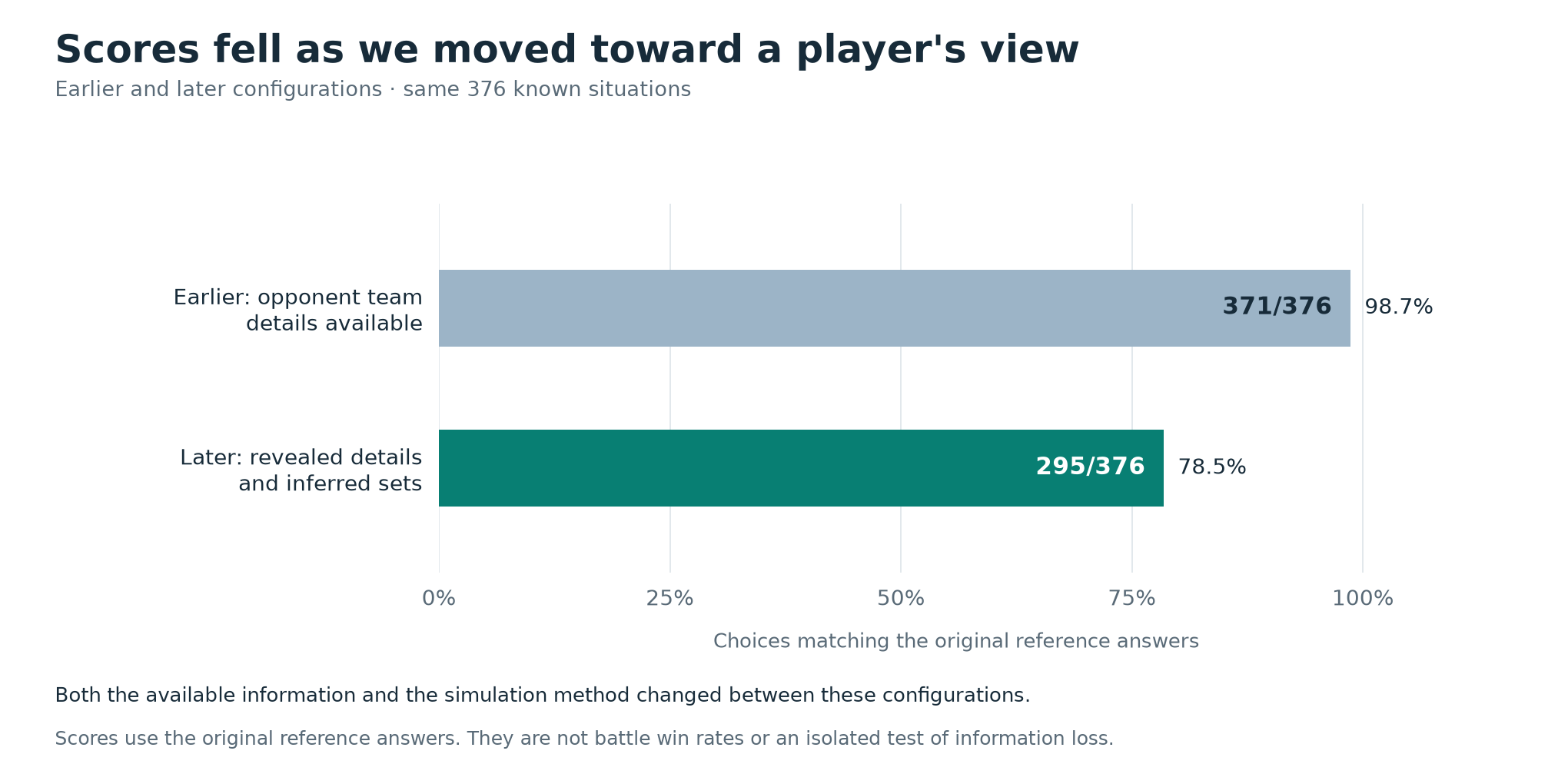
These are known development scenarios, repeatedly used while building the agent. Agreement with their reference answers is not a battle win rate or a held-out estimate of generalization. The original reports are historical records; their release recommendations describe the versions tested at that time.
The experiment, in one place.
- Read the full article on NeuroGabo.
- Explore 376 scenarios with their battle logs, 3,271 available actions, reference answers, and V4 notes.
- Download the English reading copy (Markdown) or the complete scenario collection (JSON.gz). The collection includes evaluator answers; these are separate from model requests.
- Inspect examples of what Jev received: no added context, V4, and simulation evidence.
- Download the reference wiki (ZIP, 2.6 MB): 1,364 indexed articles plus directories, structured model cards, relationships and source notes. Start with
wiki/README.mdandwiki/directory.md. - Download the full methodology (Markdown), the archived September 21 report. It describes the research and implementation at that date; the demo has since launched.
- Play against Jev and review its decisions after a battle.
What did Jev actually receive?
The baseline request contains the Showdown log and the legal action menu. V4 adds selected wiki notes; the simulation condition also supplies hypothetical consequences. These files preserve the archived requests, not a reconstructed explanation of the model’s reasoning.
For example, these three lines are copied from the archived V4 notes for the priority test:
Lucario; left; 1/145 HP; ability Inner Focus; no item.
Arcanine; left; 1% displayed HP; Speed +6; ability Flash Fire; no item.
Quick Attack: Normal, Physical, base power 40, accuracy 100%, target normal. No additional effect.
The article uses Pikachu and Mewtwo as an illustrative retelling. The recorded diagnostic case uses Lucario and Arcanine. The excerpt above is verbatim; the full request includes other rules and context. These historical requests use more disclosed set information than the current demo.
| Situation | Log only | V4 | With simulations |
|---|---|---|---|
| Priority at 1 HP | JSON | JSON | JSON |
| A switch and its entry effect | JSON | JSON | JSON |
| A decision shaped by Toxic history | JSON | JSON | JSON |
Which knowledge reaches the decision?
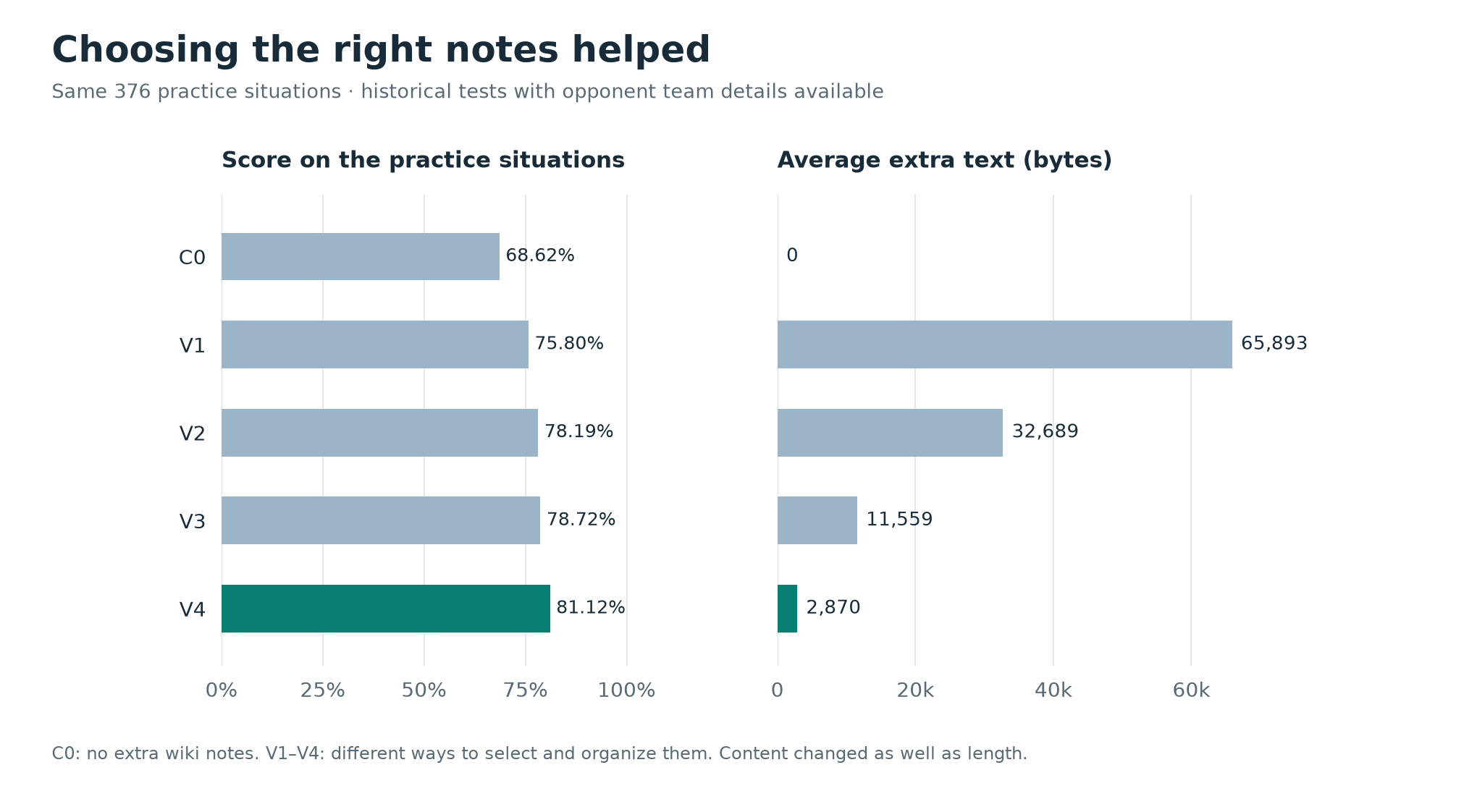
Five conditions used the same 376 battle records and action menus. V1–V4 changed the selection and organization of added wiki material. This comparison does not isolate text length as the cause of improvement.
| Condition | Accepted choices | Agreement | Mean added bytes |
|---|---|---|---|
| C0 | 258/376 | 68.6% | 0 |
| V1 | 285/376 | 75.8% | 65,893 |
| V2 | 294/376 | 78.2% | 32,689 |
| V3 | 296/376 | 78.7% | 11,559 |
| V4 | 305/376 | 81.1% | 2,870 |
Original context report (Spanish, Markdown) · Complete context results (JSON.gz)
Did reconsidering the decision help?
The review rule caught 64 of V4’s 71 mistakes, but also reconsidered 276 correct choices. The strongest review condition matched 308 of 376 reference answers, up from 305: eleven corrections and eight regressions. This was a small net gain on the same known cases.
Original review experiment (Spanish, Markdown) · Complete review results (JSON.gz)
Make the consequences easy to follow.
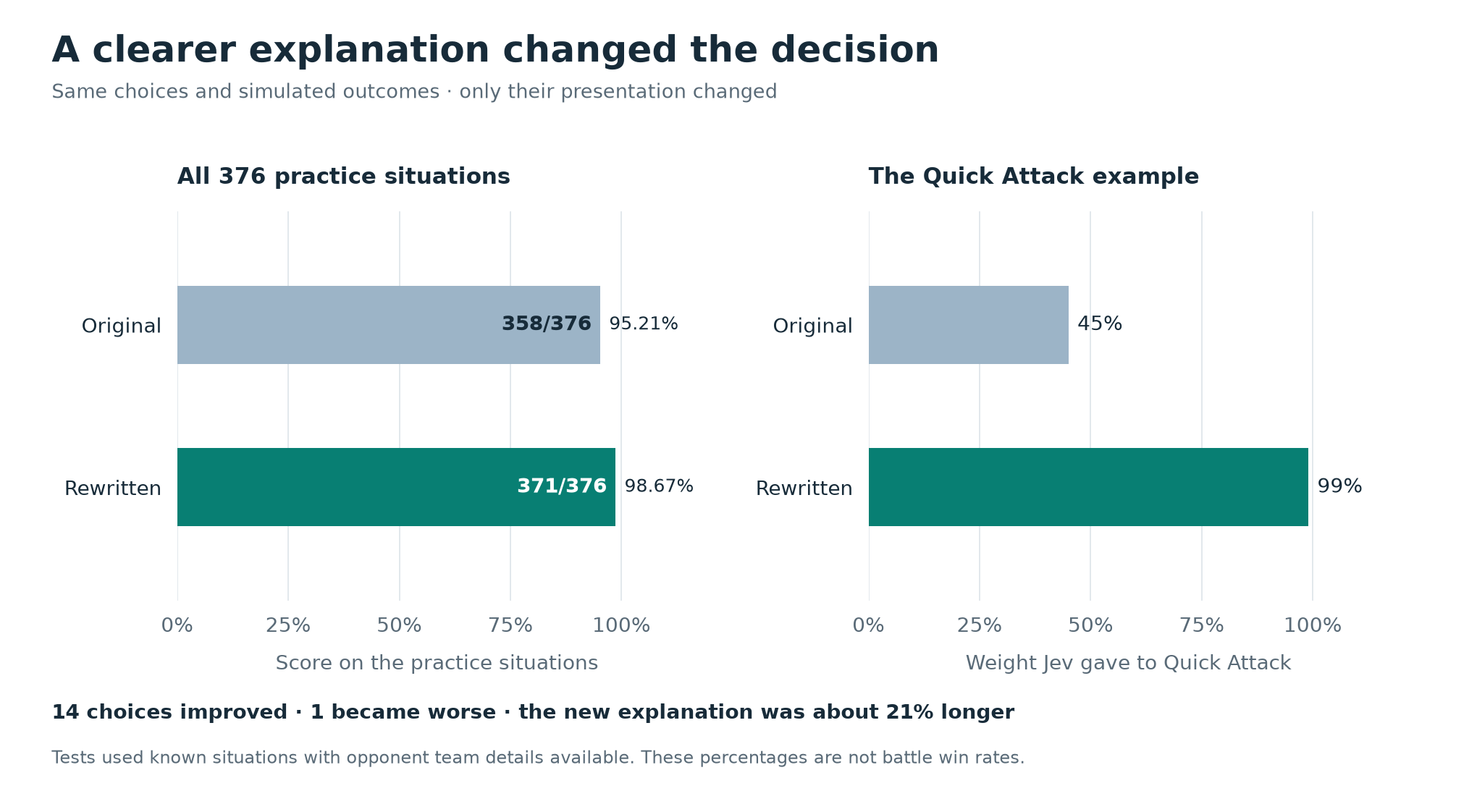
With the same model, choices, battle records, reference context, and simulated outcomes, rewriting the consequence summary increased accepted choices from 358/376 to 371/376. Fourteen decisions improved and one became worse. The summary grew approximately 21%.
In the diagnostic Quick Attack example, the model’s weight on that action changed from 45% to 99%. Those percentages describe its choice, not the chance of winning. Approximately 92% of the hypothetical branches ended the battle, which limits how broadly the result can be generalized.
Original controlled-comparison report (Spanish, Markdown) · Before (JSON.gz) · After (JSON.gz)
Explore and check the evidence.
- Browse all 376 scenarios, available actions, accepted answers, and the V4 notes.
- Download the English reading copy.
- Exact request examples and their source hashes. The requests contain no evaluator answer keys.
- Figure data and original source hashes.
- Download provenance and SHA-256 hashes. Decompressed JSON and original reports match the archived source files byte for byte.
Wiki file inventory and SHA-256 hashes. The ZIP contains the reference snapshot, not an executable game or an API credential.
Raw reports preserve their original repository-relative references. The downloadable documents and datasets linked on this page are the public evidence package; the full development repository is not part of this release. No new model evaluations were run for this publication.